




Skip to content

The Exhaustive eCommerce SEO Audit

Smart Solution's paid one-time SEO audit examines every layer of your store’s search performance. Receive a complete findings report and a prioritized action plan that is yours to keep.

When Search Performance Slides, Guessing Is Expensive

A store whose organic traffic has stalled or dropped is usually offered theories: the algorithm changed, the content is too thin, the site needs more links. Those theories may all sound reasonable, but each one calls for a different investment. The audit replaces competing opinions with a documented, prioritized explanation of what is affecting performance and what should happen next.

Declining or flat organic performance usually traces back to a small set of causes:

Algorithm Updates

Search changes may have shifted factors that influence rankings in your category.

A Migration or Replatform

Redirects, URL changes, rendering issues, or missing content may have weakened the authority your site had already earned.

Technical Decay

Crawl activity may be wasted on faceted URLs, canonical signals may conflict, or site templates may have slowed over time.

Content Decay

Pages that ranked well in the past may have been quietly outperformed by stronger or more up-to-date content.

The AI Layer

Buyers may be receiving answers from AI Overviews and assistants that never cite or recommend your business.

Authority Erosion

Competitors may be steadily building links and third-party visibility while your own authority remains unchanged.
Treating the wrong one is how stores spend a year on content while a canonical problem eats the catalog. The audit’s job is to tell you which of these is actually costing you revenue, in order, with the receipts.

What The Exhaustive Audit Covers

Exhaustive means all four layers of search performance, examined together, because they fail together. A ranking problem diagnosed without the technical layer, or a technical audit that ignores how AI surfaces read your store, answers half the question.

Technical SEO

Crawl and indexation behavior, canonical logic across filtered and variant URLs, faceted navigation governance, redirect integrity, Core Web Vitals by template, structured data health, and the platform constraints underneath all of it. This is the layer where eCommerce sites most often lose quietly: product pages sitting in “Crawled, currently not indexed” while crawl budget drains into filter permutations.

Content and Rankings

Where your rankings actually are and how they have moved, which pages decayed and which never earned a position, keyword cannibalization across categories and blog posts, content quality against what currently wins your SERPs, and the competitive gap: what rivals rank for that you do not, and why.

AI Search Visibility

Whether AI systems can crawl, interpret, and cite your store: AI-crawler access, extraction readiness of your money pages, entity clarity, and citation presence for your commercial queries. We audit this layer the evidence-based way, the same standard as our AI search visibility services; you will not find schema theater dressed up as an AI strategy in our findings.

Authority and Off-Site

Your backlink profile against the competitive set, and your presence on the third-party surfaces that both buyers and AI answers actually consult: directories, reviews, communities. Content-complete and technically clean sites still lose head terms on authority; the audit says so plainly when that is the finding.
Every layer is examined at catalog scale: category and product page treatment, faceted navigation, product variants, out-of-stock handling. We focus on the challenges that affect online stores, not brochure websites.
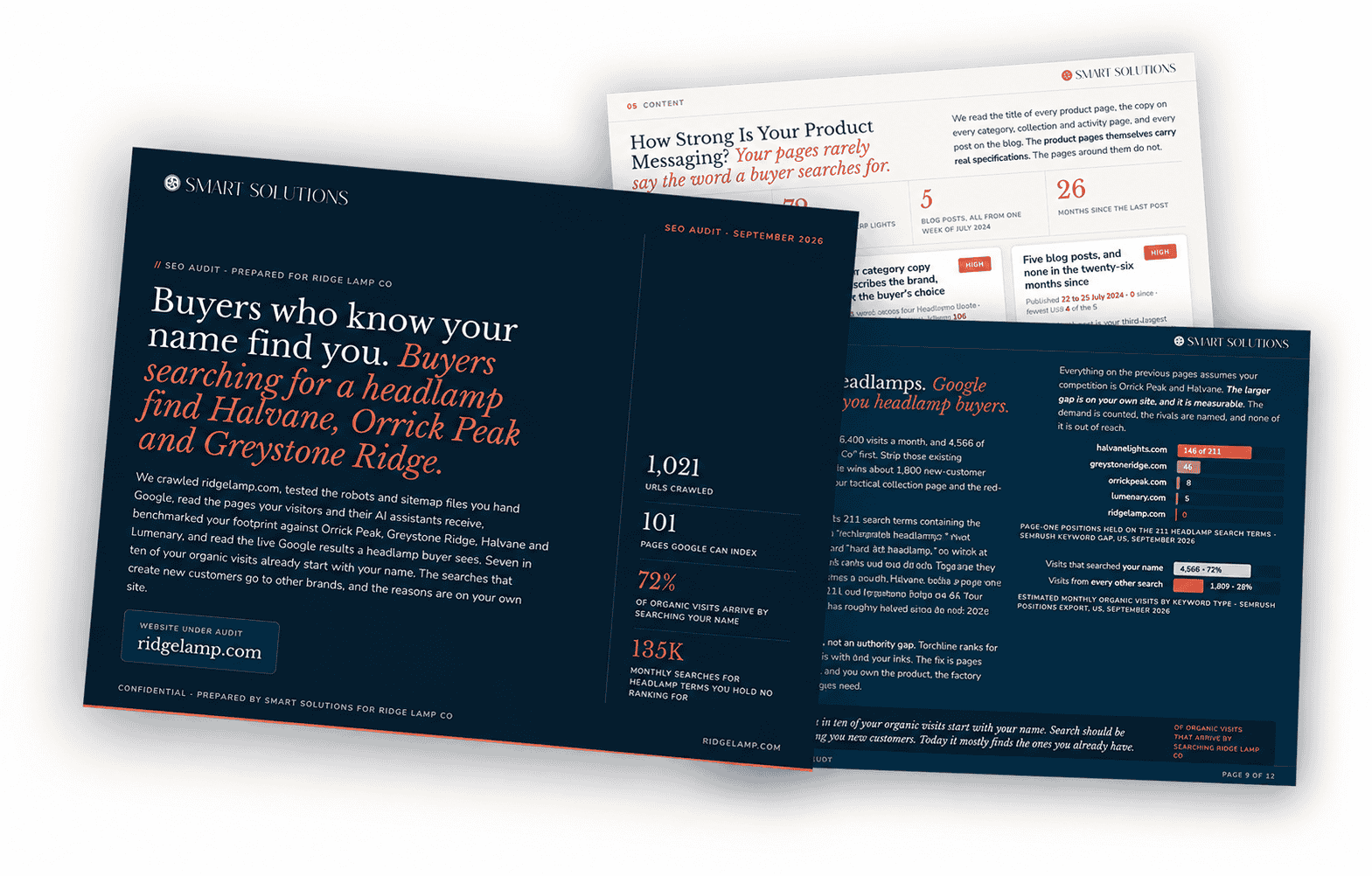
SEO Audit Mockup
the deliverables

What You Receive

The audit produces two working documents, not a presentation filled with red scores. First, you receive a complete findings report in PDF format. Every issue is documented with supporting evidence, its potential business impact, and a recommended path to resolution. The report closes with a prioritized action plan organized by revenue impact and level of effort. Second, you get a companion Workbook that lists each individual issue and includes completion tracking, turning remediation into a checklist your team can actively manage.

The report is written to be read by the person who owns the revenue, and the Workbook is built for the people who do the work. We present the findings during a debrief session, walk through the priorities, and answer your team’s questions. Nothing is withheld for a second engagement. The documents are complete and useful on their own.

computer-with-ecommerce-platforms
Honest Scoping

Scoped to the Site You Actually Have

Auditing a 30-page storefront and a 100,000-page catalog are different engagements, and honest pricing reflects that. Audit scope and cost are set by the size and complexity of your site: catalog scale, platform, template variety, and how much history needs unwinding. We scope it in a conversation, not from a rate card. We audit stores on the platforms we build on: BigCommerce, Adobe Commerce and Magento, Shopware, and WooCommerce. Platform fluency changes the diagnosis: the same symptom has different causes on different platforms, and our findings come with the configuration path, not just the observation.

If You Already Know Something Is Wrong

You do not need another opinion. You need the layer-by-layer evidence of what is costing you and what fixing it is worth. That conversation starts here.
seo-checklist
Boundaries, Stated Plainly

Standalone by Design, and What's Not Included

The audit is a complete engagement, not a teaser. You keep every finding, the full action plan, and the Workbook, and they are written so any competent team can implement them: yours, ours, or another vendor’s. Many clients do ask us to run the remediation, because the people who found the problems are fastest at fixing them. That is a choice the audit informs, not a condition it hides.

What the audit is not:

  • It is not implementation. The audit diagnoses and prioritizes; fixing is a separate, clearly scoped decision

  • It is not an ongoing SEO program. No retainer is attached to it.
  • It is not a paid-media or PPC review. Organic and AI search only.
  • It is not a tool subscription or an automated scan. Senior practitioners run it; software assists them, not the reverse.

How the Audit Runs

Timeline scales with the site: a focused storefront and a six-figure-URL catalog are not the same project, and we will give you the honest estimate at scoping rather than a number designed to win the deal.

Define Collect Sequence Execute
eCommerce Discovery & Strategy

Scoping

A conversation about your site, your platform, what slid and when, and what data you have (Search Console, analytics, logs). Scope and timeline are set here, sized to your catalog.

Evidence Gathering

Gather Evidence

Full technical crawl, rankings and competitive data, AI-visibility checks, authority analysis, validated against your Search Console and analytics rather than tool guesses.

eCommerce Analysis

Analysis and Prioritization

Findings tied to business consequence and sequenced by revenue impact and effort. The severity is documented, not dramatized.
eCommerce Execution

Delivery and Debrief

The full PDF report, the tracking Workbook, and a working session to walk the priorities and answer questions.
seo-analytics
Proof

The Machinery Is Real

The quality of an audit depends on who conducts it and what they have solved before. Our auditors are the same senior team responsible for our SEO and engineering work. Our SEO experts each bring more than a decade of experience across D2C, B2B, and lead-generation businesses, including regulated firearms retail, apparel, consumer goods, universities, and hospitals.

The findings translate into results because they are supported by real implementation experience. For Spartan Blades, technical remediation increased the number of healthy, indexable URLs and reduced Cumulative Layout Shift across desktop and mobile. For Army Navy Sales, an SEO program built on the same diagnostic discipline contributed to 852% organic revenue growth.

The AI visibility layer also reflects active client work, not an added checklist. Our team is already helping merchants improve how LLMs and Google’s AI Overviews crawl, interpret, and cite their websites.

Frequently Asked Questions

An eCommerce SEO audit is a systematic examination of everything that determines your store’s organic search performance: technical crawlability and indexation, content and rankings, site architecture, authority, and, done properly in 2026, AI search visibility. The output is a documented, prioritized list of what is holding your store back and what fixing each item is worth, specific to catalog-scale problems like faceted navigation and product variants.
Scale and store mechanics. A store generates thousands of URLs from products, categories, filters, and variants, so the highest-impact problems live in places a brochure-site audit never looks: crawl budget allocation, canonical logic across variants, out-of-stock handling, category architecture, and product feed health. An audit that does not treat those as first-class subjects will miss what is actually costing an eCommerce site revenue.
Cost is set by the size and complexity of your site. A 30-page storefront and a 100,000-page catalog require very different depths of crawling, analysis, and documentation, so we scope each audit individually after a conversation about your store and your situation. What we can say flatly: it is a one-time engagement with no retainer attached, and the deliverables are yours regardless of what you do next.
Timeline scales with catalog size and how much history needs unwinding, so we commit to a schedule at scoping rather than quoting one number for every store. You will know the timeline before the engagement starts, and the debrief is booked when the work begins, not left open-ended.
You receive the full findings PDF closing with a prioritized action plan, the issue-by-issue Workbook with completion tracking, and a debrief session. After that, the decision is yours: implement with your own team, another vendor, or us. The documents are written to stand alone either way. Most clients use the debrief to decide which priorities to move on first.
Yes, as a first-class layer. We check whether AI systems can crawl and interpret your store, whether your money pages are extraction-ready, and whether AI answers cite you for your commercial queries. We hold that layer to the same evidence standard as our AI search visibility service: findings name what actually moves AI citations, and we will tell you plainly when something sold as an AI fix does not.

Unlock More eCommerce Growth

When organic performance is underwhelming and the explanations keep changing, start with the evidence.One engagement, every layer, a plan your team can execute, and no obligation beyond it. Tell us about your store and we will scope it honestly.
logo-symbol