







AI Search Visibility: Generative Engine Optimization (GEO) Services
We build the structure, entity clarity, and original substance that earn AI citations, and we tell you plainly what does not work, with sources.
What Is Generative Engine Optimization (and AEO)?
Generative engine optimization is the practice of structuring your content and online presence so AI systems like Google’s AI Overviews, ChatGPT, and Perplexity can find, understand, and cite it when they answer your buyers. Answer engine optimization is the same discipline, named for answer engines. Neither replaces SEO. Both extend it.
| Optimizes For | The Win Looks Like | |
| SEO | Search-engine rankings | Your page in the results |
| AEO | Answer boxes and answer engines | Your content as the direct answer |
| GEO | AI-generated responses | Your brand cited inside the AI's answer |
The vocabulary is younger than the practice. Google’s own guidance on AI features says the mechanism is ordinary search: your page must be indexed and eligible to appear in Search for AI features to use it at all. That is why this service lives inside our eCommerce SEO services, not beside them.
What Our AI Search Visibility Services Include
Our AI visibility work focuses on the practices supported by evidence: content structured for extraction, unambiguous entities, original material worth citing, and the technical foundation that makes any of it possible. Each engagement begins with an assessment of how AI search surfaces treat your catalog, products, and priority search queries today.
Extraction-Ready Structure
Direct answers at the top of pages and sections, clean headings, lists and tables where they genuinely fit. The same structure that won featured snippets is what AI systems lift.Entity Clarity
Consistent naming for your brand, products, and categories across your site and the profiles that describe you, so machines resolve who you are without guessing.Original, First-Hand Substance
AI systems cite material that says something new: real data, named results, first-hand experience. We build content programs around what your business can actually evidence.Technical Readiness
Crawlability, indexation, rendering, and Bing indexation for the ChatGPT layer. If AI systems cannot read your content, they can’t recommend it.Product Feed and Merchant Center Hygiene
For shopping-related AI features, Google’s guidance points to one product-specific lever: your Merchant Center feed. We keep it clean, complete, and eligible.Off-Site Structure Strategy
AI answers about “best” and “who should I hire” lean on third-party surfaces. We identify which directories, reviews, and communities the engines actually cite for your queries and flag the gaps.Measurement
Citation presence per target query, tracked honestly. Detail below, because this is where the market is weakest.What We Won't Sell You
Several deliverables commonly sold as GEO have no evidence behind them, and some are contradicted by Google’s own documentation. We do not sell them, and we will tell you if someone else is trying to.
Schema Markup as an AI-Visibility Lever
Google’s AI-features guidance states there is no special structured data you need to add for generative AI search. The only controlled test we know of, an Ahrefs study of 1,885 pages adding JSON-LD against 4,000 controls (August 2025 to March 2026), found no significant citation lift on AI Mode or ChatGPT. Schema still earns rich results and clarifies entities. That is what we use it for, and all we claim for it.Llms.txt Files
Google states that these files neither harm nor help your visibility, and no major AI company has confirmed consuming them. A five-minute file is harmless. Billing you for it is not.Writing "for AI" as a Packaged Style
Google’s guidance is explicit: no special writing style, no required chunking, no ideal page length. Clear, well-structured, people-first content is the whole instruction.Mention-Volume Campaigns
Google flags that seeking inauthentic mentions across the web is not as helpful as it might seem. Real authority on surfaces AI systems cite matters. Bulk-manufactured mentions do not.When AI Answers Your Buyers Before You Do
Ask ChatGPT or Google about your product category and see who gets named. If it is not you, the fix starts with an assessment, not a schema plugin.How AI Engines Actually Pick Their Sources
AI search is not one system. Google documents that its AI features decompose a question into multiple related searches, a mechanism called query fan-out, and retrieve passages per sub-question. And rankings no longer guarantee citations: in Ahrefs' March 2026 study of 863,000 SERPs, only about 38% of AI Overview citations ranked in the organic top 10 for the triggering query.
| Engine | How It Retrieves | The Win Looks Like |
| Google AI Overviews | Search index + query fan-out | Extractable answers, front-loaded; fresh, structured pages |
| Google AI Mode | Deeper fan-out; cites differently than AIO (13.7% same-URL overlap, Ahrefs, Sep 2025) | Coverage of the sub-questions, consistent brand naming |
| ChatGPT | Bing’s index plus OpenAI’s own crawling | Bring indexation; specific, dated, citable numbers |
| Perplexity | Its own crawler, strong freshness skew | Short, answer-first, current content |
| Gemini | Document Google Search grounding | Classic Google SEO carries over |
The practical consequence: one strong page is retrieved for sub-questions you never targeted, if its sections stand alone. That is how we structure yours.
AI Visibility for eCommerce Catalogs
Generic GEO advice stops at articles. A store’s AI visibility lives at the catalog level: whether an assistant can resolve your products, trust your availability data, and surface your pages when a buyer asks for “the best X under Y.” That takes catalog work, not blog posts.
The levers are specific. Product and category pages that answer buyer questions in extractable form. Review content with real attributes machines can parse. A Merchant Center feed that is complete and current, which is the one product-specific recommendation in Google’s own AI guidance. Entity-clean brand and product naming across the catalog. This is the same catalog discipline that supports strong eCommerce SEO, extended to help AI systems understand and recommend your products.

AI Visibility Where Google Shopping Is Closed
For regulated categories like firearms, Google Shopping listings and Product rich results are unavailable by policy, and AI assistants increasingly stand between buyers and the open web. That makes AI-readable organic content more important for these merchants, not less. It is a constraint set we already work inside.
Smart Solutions serves firearm-friendly and 2A merchants as a lead vertical. When the paid and shopping surfaces are closed, category authority, entity clarity, and citable first-hand content carry the entire discovery load, in classic search and in AI answers alike. No other provider in this market addresses that scenario at all; we build for it as a matter of course.
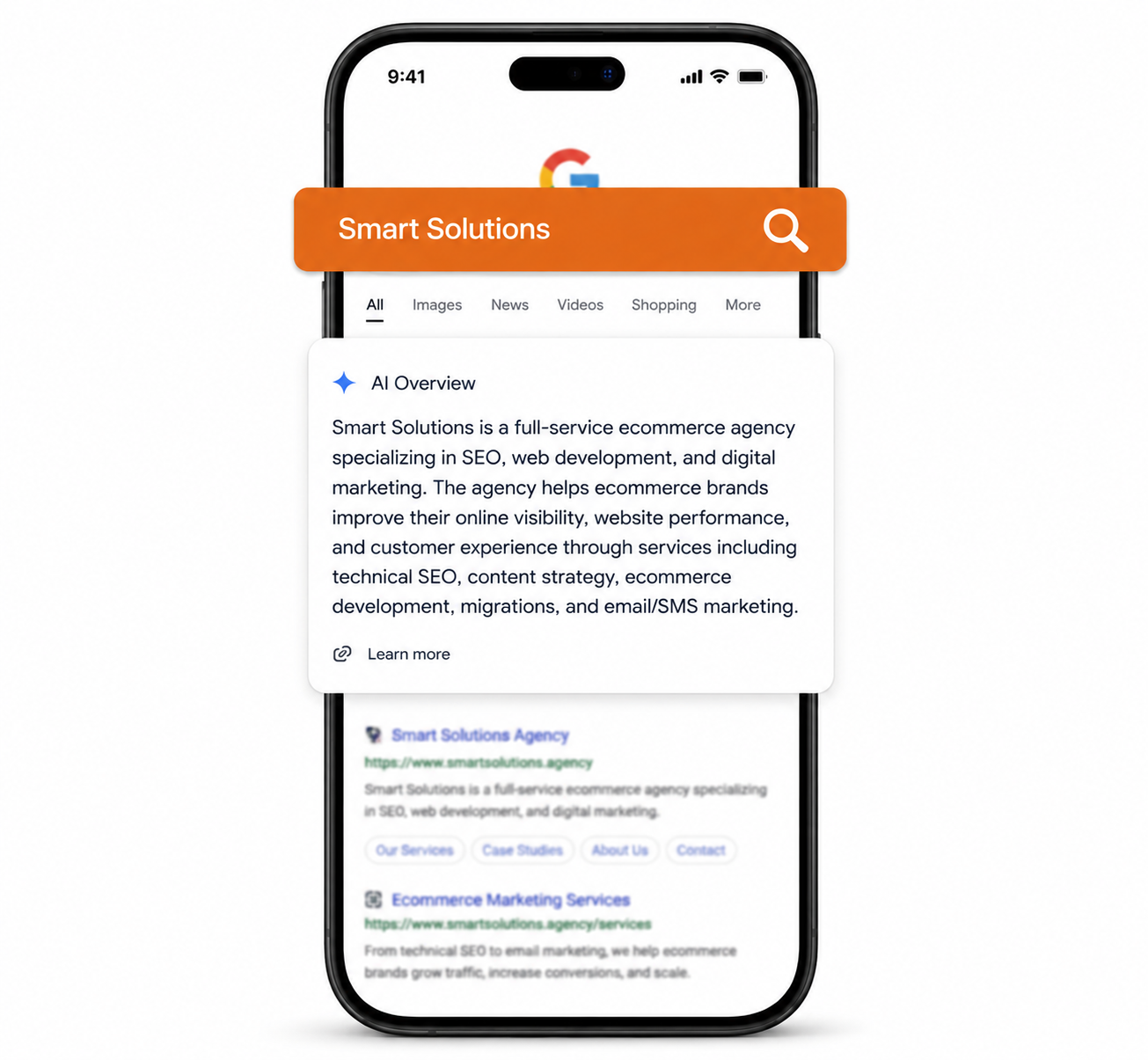
Success Story
A leading NFA retailer came to us with strong brand authority, but a catalog AI systems couldn't understand: thin metadata, inconsistent product names, content that didn't answer buyer questions. Smart Solutions rebuilt the foundation, and organic growth followed.
How We Measure AI Visibility (Honestly)
We measure AI visibility as citation presence: for an agreed set of money queries, does the engine’s answer cite or name you, checked on a fixed schedule and reported with the sampling method disclosed. We track qualified outcomes in analytics alongside it. What we do not do is report a precise “AI rank,” because answer engines are non-deterministic and the same prompt returns different answers across sessions.
Three honesty notes competitors will not give you. First, tools that track AI share of voice, and there are credible ones, are sampling instruments, not rankings; treat their trends as directional. Second, expect fewer clicks and better clicks: Pew’s behavioral data (March 2025) measured result clicks falling from 15% to 8% when an AI Overview is present, while Semrush finds AI-referred visitors convert at roughly 4.4 times the rate of traditional organic. Third, many citations are anonymous: Semrush analysis finds 61.7% of AI citations link to a source without naming the brand, which is why entity work and comparative content, where brands get named, are part of the program.
You see the same dashboard we do, and the first report establishes the baseline before we claim any movement.
Built on the Same Foundation as Our SEO
Google’s guidance reduces AI-feature eligibility to something unglamorous: be indexed, be snippet-eligible, be genuinely useful. In other words, AI search visibility is disciplined SEO extended to a second consumer, and vendors selling it as a separate discipline are selling a second invoice for the same foundation.
That is why this service is a spoke of our eCommerce SEO services and rests on the same technical base described in our technical SEO foundation. Our track record in classic organic search, including Army Navy Sales' 852% organic revenue growth, is SEO proof, and we label it that way. AI search visibility is newer for everyone, and we are not waiting for the playbook to settle: our SEO team is optimizing client sites today for how LLMs and Google’s AI Overviews crawl, interpret, and cite the web, so the practice on this page is working practice, not a repackaged pitch. See our SEO results for the foundation this builds on.
Frequently Asked Questions
GEO extends SEO rather than replacing it. Google’s own AI-features guidance says foundational SEO best practices are the mechanism, and a page must be indexed and snippet-eligible before AI features can use it. What GEO adds is emphasis: extraction-ready structure, entity clarity, original citable substance, and measurement of citations rather than only rankings. If someone sells you GEO without SEO underneath, ask what the AI is supposed to cite.